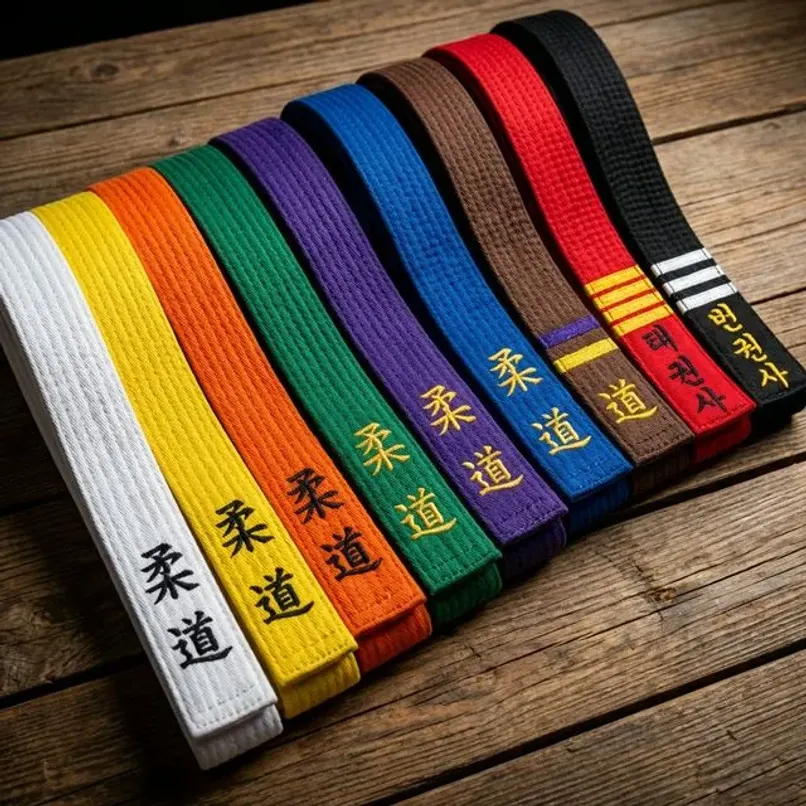
In Taekwondo, the belt is more than just a piece of fabric holding your uniform together. It is a visual representation of your knowledge, skill, and dedication.
At Superior Taekwondo, we adhere to the official World Taekwondo (WT) and Kukkiwon grading system. This ensures that the rank you earn in our Helensville dojang is recognized globally, from Seoul to Los Angeles to London.
The Belt Hierarchy
Meaning: Innocence. A beginner with no previous knowledge of Taekwondo.
Meaning: Earth. The foundation is being laid for a plant to take root and grow.
Meaning: Growth. The plant's leaves start to grow as skill develops.
Meaning: Sky. The plant grows towards the blue sky as training progresses.
Meaning: Danger. A warning to the student to exercise control and to the opponent to beware.
Meaning: Maturity. Opposite of white, signifying mastery and imperviousness to darkness/fear.
Timeline to Black Belt
While every student involves at their own pace, here is a general guideline for consistent students training 2-3 times per week.
Beginner (White - Yellow)
0 - 12 Months
Focus on basic stances, flexibility, and etiquette. Learning the first patterns (Taegeuk Il Jang).
Intermediate (Green - Blue)
1 - 2.5 Years
Introduction to sparring, board breaking, and more complex combinations. Refining technique.
Advanced (Red - Cho Dan Bo)
2.5 - 3.5 Years
Mastering advanced kicks (spinning), leadership skills, and preparation for the rigorous Black Belt grading.
Black Belt (1st Dan)
3.5 - 5 Years
Completion of the basic curriculum. The student is now considered a serious practitioner ready to begin advanced learning.
The Grading Day
Gradings are formal examinations overseen by a certified Master Instructor. They are designed to test your physical and mental readiness for the next level.
Performing set sequences of defense and attack with precision.
Demonstrating practical application against a partner.
Breaking wooden boards to test power and focus (usually green belt+).
Answering questions about Korean terms and Taekwondo history.
Grading FAQ
How long does it take to get a Black Belt in Taekwondo?
Typically, it takes between 3 to 5 years of consistent training to achieve a 1st Dan Black Belt. This depends on the student's dedication, frequency of training, and ability to pass regular gradings.
What is the difference between Kup and Dan grades?
Kup grades are the colored belts (beginner to intermediate), counting down from 10th Kup (White Belt) to 1st Kup (Red Belt with Black Tip). Dan grades are the Black Belt ranks (expert), counting up from 1st Dan to 9th Dan.
How often are gradings held?
At Superior Taekwondo, color belt gradings are typically held every 3-4 months. Students must show improvement in techniques, patterns (Poomsae), and sparring to be eligible to grade.
What is the minimum age for a Black Belt?
Students under 15 years old receive a 'Poom' rank (Junior Black Belt), which converts to a 'Dan' rank (Adult Black Belt) when they turn 15. There is no maximum age!
Do I have to spar to get my belts?
Sparring is a requirement for most belt levels as it demonstrates the practical application of techniques. However, for lower belts, this is light contact and focuses on controlled movement.