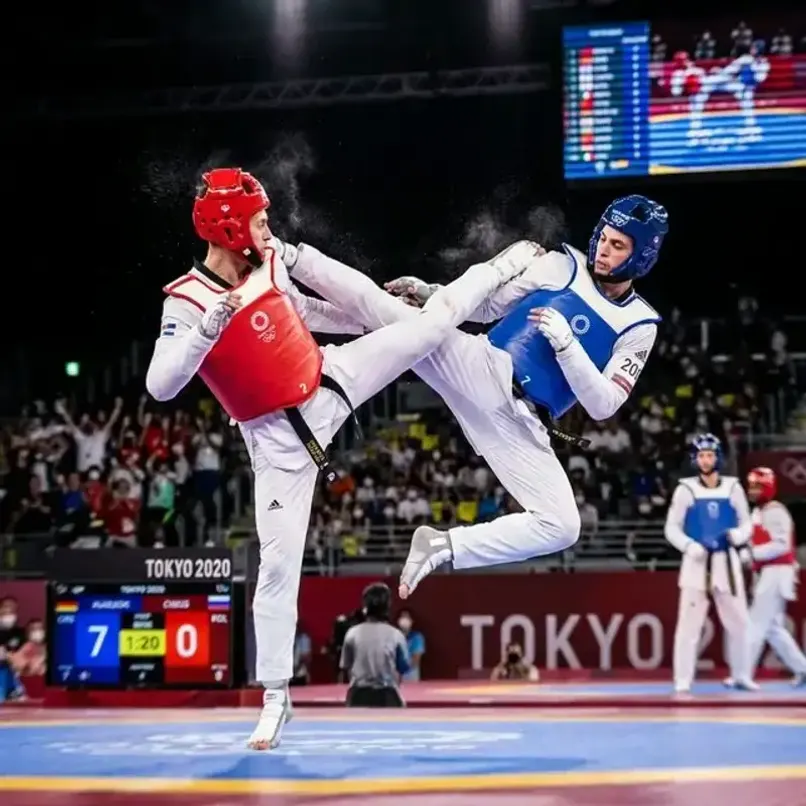
To succeed in modern Taekwondo, athleticism is not enough. You must understand the game.
Following the Paris 2024 Olympics, World Taekwondo has ratified significant changes effective for the 2025-2026 cycle leading into the Los Angeles 2028 Games. At Superior Taekwondo, our competition team trains directly to these new standards, ensuring our athletes are always one step ahead.
The "Best of 3" System
Gone are the days of cumulative scoring where a player could build a massive lead and stall. Now, every round starts at 0-0.
Athletes must fight for every round. Losing the first round doesn't mean the match is over; it's a fresh start in round 2.
If one player leads by 12 points at any time during a round, they win that round immediately (Point Gap).
Strategy Shift
"This system rewards aggressive, high-scoring players who can explode into action from the very first second."
2026 Rule Updates
6-Point Head Kicks
In a bid to bring back spectacular techniques, World Taekwondo has doubled the base points for spinning kicks to the head.
- Old Rule: 5 points (3 Head + 2 Turn)
- New Rule: 6 points (Double the 3-point base)
No Head Kick Replays
To keep the match flowing, coaches can no longer request video replay for head kicks.
This responsibility now lies solely with the center referee and corner judges. This eliminates tactical delays and forces coaches to save their quota cards for technical errors.
"Let Them Fight"
Referees are instructed to minimize stoppages for minor clinching.
Unless a player is holding to effect a foul or stall, the fight continues. This favors athletes who are comfortable fighting in close quarters (clinch range).
Semi-Auto Punches
New PSS gloves are being introduced that detect impact.
However, points are not automatic. A sensor trigger alerts the judges, who then validate if the technique was correct. This ensures hard, clean punches are rewarded.
Valid Points & Penalties
Points
- Punch to Body 1 Pt
- Kick to Body 2 Pts
- Turning Kick to Body 4 Pts
- Kick to Head 3 Pts
- Turning Kick to Head 6 Pts (New!)
Gam-jeom (Penalties)
Each Gam-jeom gives 1 point to the opponent.
- • Crossing the boundary line
- • Falling down
- • Avoiding or delaying the match
- • Grabbing or pushing the opponent
- • Lifting the leg without attacking (Monkey Kick)
- • Attacking below the waist
- • Attacking after Kal-yeo (break)
Train for the Future
The rules of Taekwondo change, but the goal remains the same: Excellence. At Superior Taekwondo in Helensville, we don't just teach you how to kick; we teach you how to win under the current and future rule sets.
Rules FAQ
What is the 'Best of 3' system?
Matches are decided by who wins the most rounds, not the total score. A player must win 2 out of 3 rounds to win the match. If a player wins the first two rounds, the match ends immediately.
How many points is a head kick?
A standard head kick is 3 points. However, under new dynamic rules, a turning (spinning) head kick is now awarded 6 points (double the base score) to encourage spectacular techniques.
What happens if the scores are tied at the end of a round?
The round is decided by criteria in this order: 1) Most points scored by turning kicks, 2) Highest order of technical value, 3) Who received fewer penalties (Gam-jeom), 4) Referee decision (superiority).
Can coaches ask for video replay for head kicks?
Under the new 2026 protocols, coaches can NO LONGER request Instant Video Replay (IVR) for head kicks. This can only be initiated by the center referee to speed up the game.
What are valid scoring areas?
Valid scoring areas are the trunk protector (blue or red hogu) covered by sensors, and the entire head above the collarbone. Punches are only valid to the trunk, not the head.