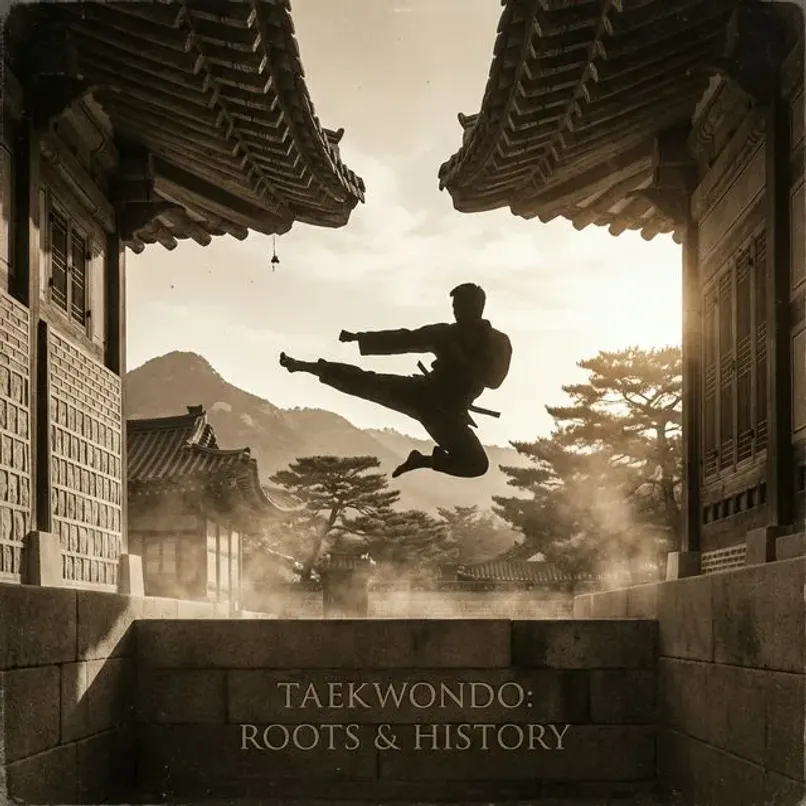
Taekwondo got its name on 11 April 1955, when the heads of Korea's martial-arts schools agreed on a single name for the art they had been developing since the first kwans opened in Seoul in 1945. It became a full Olympic medal sport at Sydney 2000.
When was Taekwondo invented?
Post-liberation, five major martial arts schools (Kwans) opened: Chung Do Kwan, Moo Duk Kwan, Yun Moo Kwan, Chang Moo Kwan, and Song Moo Kwan. Later, four more joined to form the 9 original Kwans.
1955: The Naming
General Choi Hong Hi proposed the name "Taekwondo" to a committee on 11 April 1955. It was chosen for its similarity to "Taekkyeon" and its descriptive meaning (Foot, Fist, Way).
1966: ITF Formed
The International Taekwon-Do Federation was established to promote the art globally.
1973: WT Formed
The World Taekwondo Federation (now WT) was established in Seoul, separating the martial art into two distinct paths: the traditional ITF style and the sport-focused WT style.
To practice Taekwondo is to participate in a history that spans millennia. Every bow, every form, and every command in the dojang echoes the traditions of the past.
At Superior Taekwondo, we teach more than just kicking and punching. We teach a heritage. Whether you are training in our Helensville dojang or competing internationally, you are part of a lineage that has survived wars, occupations, and rigorous modernization to become the Olympic sport we love today.
Where did Taekwondo come from?
The history of Korean martial arts begins in the era of the Three Kingdoms: Goguryeo, Baekje, and Silla (57 BC - 668 AD). Archaeological findings, such as murals in the Muyongchong (Royal Tomb of the Dancers), depict warriors engaging in unarmed combat resembling modern Taekwondo.
Two primary indigenous arts emerged during this time:
- Subak (수박): A fighting style focusing on hand strikes and grappling.
- Taekkyeon (택견): A fluid, rhythmic art emphasizing high, fluid kicks and footwork. This art is the primary ancestor of Taekwondo's dynamic kicking style.
The Hwarang Warriors
The Silla kingdom, though the smallest, became powerful through its youth warrior corps known as the Hwarang ("Flowering Knights").
The Hwarang were young noblemen trained in philosophy, poetry, horse riding, swordsmanship, and unarmed combat (Subak). They were renowned for their discipline and code of ethics.
Their five-point code of conduct, the Sesok Ogye, laid the spiritual foundation for modern Taekwondo philosophy:
- Loyalty to one's country
- Respect for one's parents
- Faithfulness to one's spouse/friends
- Courage in battle
- Justice in taking life (avoiding unnecessary killing)
"They trained consistently throughout the four seasons, honing their bodies and minds to protect their nation."
- Ancient Historical Records
Curious to try it? Superior Taekwondo runs classes for kids, teens and adults in North West Auckland, and the first one is free.
See our classesWhy was Taekwondo created?
The Joseon Dynasty
During the Joseon Dynasty (1392-1910), Confucianism replaced Buddhism as the state ideology. Scholarly pursuits were valued over martial arts, causing Subak and Taekkyeon to decline, practiced only as folk games by commoners.
The Japanese Occupation (1910-1945)
Korea's annexation by Japan brought a ban on all Korean cultural practices, including martial arts. When Korea was liberated in 1945, masters wanted a Korean martial art of their own again, and set about reviving and unifying the schools that had kept the old arts alive in secret.
That drive to unify the many post-liberation kwans under one name and one identity is what led directly to the naming committee of 11 April 1955.
When did Taekwondo join the Olympics?
World Taekwondo (WT) focused heavily on sport application. This dedication paid off when Taekwondo appeared as a demonstration sport at the 1988 Seoul Olympics and 1992 Barcelona Olympics.
It became an official full-medal sport at the 2000 Sydney Olympics, cementing its status as a global phenomenon.
Recent innovations include electronic scoring systems (PSS) introduced in 2012 to ensure fairness, making the sport faster and more transparent.
Why We Choose WT
Superior Taekwondo is proud to be a WT-style club. This connects our students to the official Olympic pathway, allowing access to sanctioned tournaments, widely recognized black belt certification (Kukkiwon), and the most modern training methodologies.
How is Taekwondo different from karate?
During the Japanese occupation, many Koreans studying in Japan learned Karate (Kong Soo Do). When Korea was liberated in 1945, masters returned with a unique blend of skills: the linear, powerful strikes of Karate combined with the fluid, high-kicking traditions of ancient Taekkyeon.
That blend is still what sets Taekwondo apart today. Where Karate is built primarily around linear hand strikes, Taekwondo blends those strikes with the circular, high-kicking techniques inherited from Taekkyeon, giving it its distinctive kick-focused style.
Continuing the Legacy in North West Auckland
History is not just about the past; it is being written every day in the dojang. When you train at Superior Taekwondo in Helensville, you are carrying the torch passed down from the Hwarang warriors through generations of masters.
Are you ready to become part of this history?
Historical Notes & FAQ
When was Taekwondo invented?
Taekwondo got its name on 11 April 1955, when a committee of Korean masters agreed on a single name for the martial art the kwans had been developing since 1945.
Where did Taekwondo come from?
Taekwondo's roots trace back to the Three Kingdoms era of Korea, where the arts of Subak and Taekkyeon developed alongside the Hwarang warrior code of the Silla kingdom.
Why was Taekwondo created?
After centuries of decline under the Joseon Dynasty and a ban on Korean martial arts during the Japanese occupation, masters returning after Korea's 1945 liberation unified their schools into one Korean martial art with its own name and identity.
When did Taekwondo join the Olympics?
Taekwondo appeared as a demonstration sport at the 1988 Seoul and 1992 Barcelona Olympics before becoming an official full-medal sport at the 2000 Sydney Olympics.
How is Taekwondo different from karate?
Many Korean masters studied Karate during the Japanese occupation, but Taekwondo blends Karate's linear strikes with the circular, high-kicking techniques of the indigenous Korean art Taekkyeon, giving it its distinctive kick-focused style.